 Robotically Manipulated Payload Challenge
The FFR robotic arm
Payloads selected for this challenge will be manipulated by the robotic arm developed by Motiv Space Systems aboard the Fly Foundational Robots (FFR) spacecraft. The arm will be mounted to the FFR payload deck and capable of end-over-end walking and repositioning of Orbital Replacement Units (ORUs) in microgravity.
The arm’s end effectors are active CrossLink cleats — one on each side — that can interface with passive CrossLink cleats mounted on the payload deck or on an ORU. During manipulation, the arm is capable of supplying power and data to a grappled ORU through its end effector. Details such as the arm’s reach and workspace envelope, force and torque sensing, and its DH parameters and joint limits are not currently published. Teams should refer to the arm CAD provided in the technical overview document linked in the next paragraph and state their design assumptions.
The nominal concept of operations for a challenge payload is as follows: a delivery vehicle hosting the winning payloads from this challenge will rendezvous with the FFR spacecraft already in orbit; the robotic arm will transfer each payload from the delivery vehicle and install it onto the FFR platform via one of the available separable interfaces; the arm will then interact with, manipulate, or reconfigure the payload according to the demonstration plan developed by the team.
For more detailed diagrams and CAD models of the robotic arm and interfaces, please refer to the technical overview document.
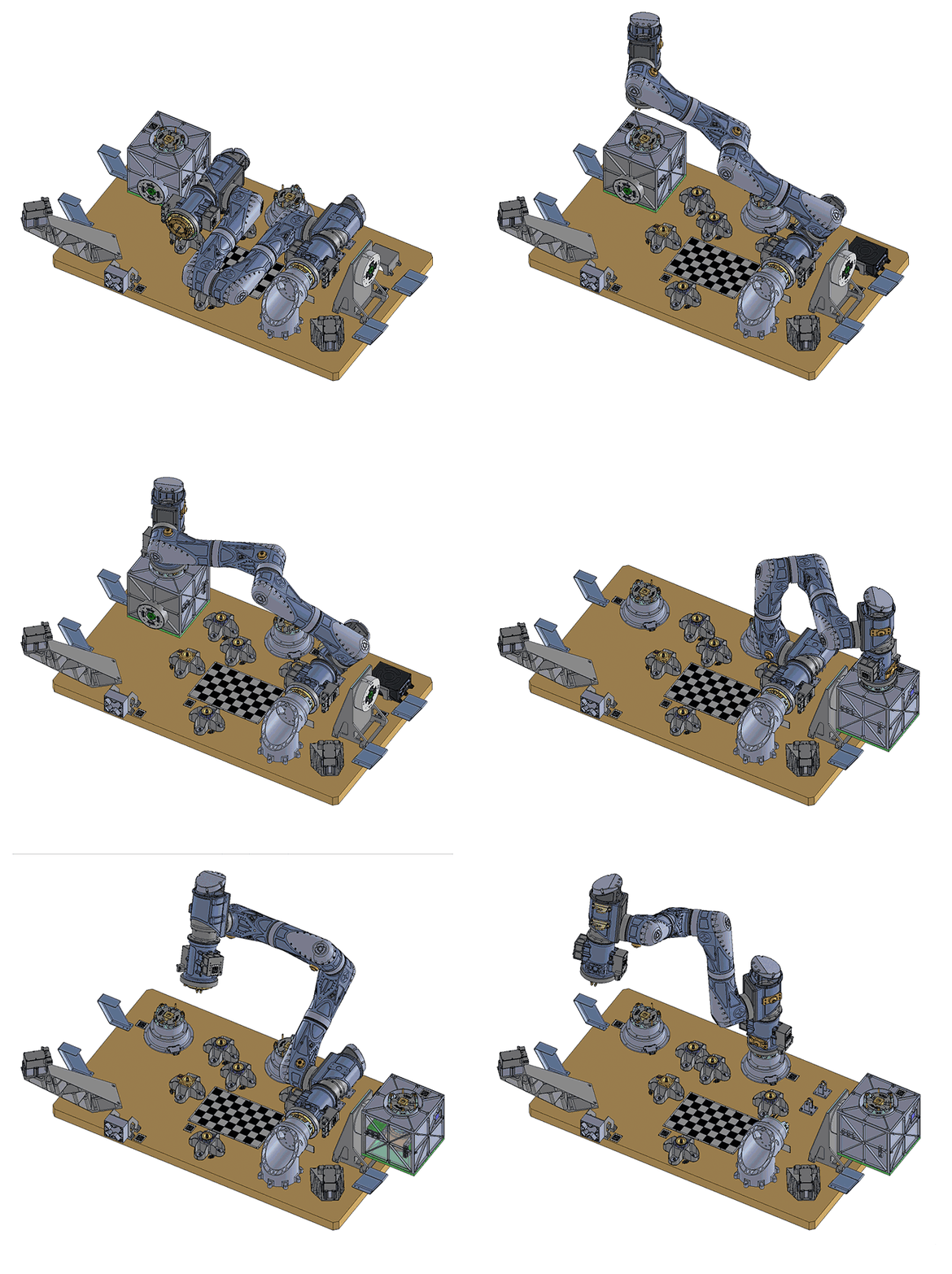
Examples of manipulation and potential demonstrations
The following examples are illustrative of the types of demonstrations that would be compatible with this challenge. This list is not exhaustive — applicants are encouraged to propose novel demonstrations that advance ISAM capabilities.
- Robotic inspection and diagnostics: a payload that, once installed on the FFR platform, deploys sensors or instruments that the arm can position, reorient, or activate to inspect spacecraft surfaces or components.
- Modular payload swapping: a payload designed to be detached from one interface, repositioned, and secured at another location on the deck, demonstrating on-orbit reconfiguration of modular systems.
- Structural assembly: a payload that includes components the arm can manipulate and connect in orbit, demonstrating building-block approaches to in-space construction.
- Sensor deployment: a payload containing a folded or stowed instrument that the arm deploys, orients, or activates in orbit.
- Material processing: a payload that exposes materials or samples to the space environment and is repositioned or reconfigured by the arm at defined intervals.
- Other novel demonstrations: Applicants are encouraged to propose demonstrations not listed here, provided the concept advances ISAM capabilities and meets the technical requirements described in this document.
All demonstrations must be designed around the arm physically interacting with the payload — passively carrying an instrument from point A to point B does not constitute manipulation for the purposes of this challenge.
Payload form factor and requirements
1. Interface (mandatory)
All payloads must incorporate a separable interface to enable mechanical docking to the FFR platform and manipulation by the robotic arm. Though teams do not need to design a separate docking structure for the delivery vehicle, they will need to select an interface with the delivery vehicle.
Payloads must be designed to the mating interface specifications published in the FFR Payload Separable Interfaces document. There is no secondary grasping or attachment point beyond the CrossLink active interface. The arm interfaces with a payload only through its CrossLink connection.
A payload may include its own additional robotic arm or actuators. Teams should clearly describe any such mechanism and how it operates in their application. NASA will provide one of the interfaces listed below to each winner. Teams may propose a preferred interface in their application; however, final assignment of an interface will be made at the beginning of Phase 2 based on the team’s preference combined with NASA’s assessment of proposed payload design and flight demonstration plan.
Note: Each of the three separable interfaces (CrossLink Cleat, iSSI, and FuseBlox) has a documented power rating in its interface details, and that rating is the power-draw limit for a payload on that interface.
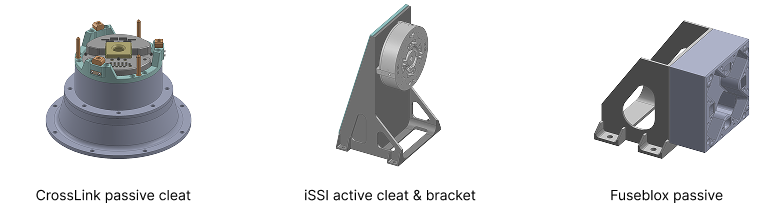
CrossLink Cleat (passive)
- Deck interface dimensions: 172mm × 111mm
- Mating interface: active CrossLink Cleat (robotic arm end effector)
- Power available: 28V at 3A (RA power); 24–32V at 3A (heater power); chassis ground
- Data available: 2x RS422 channels; ESTOP
- Two passive CrossLink Cleat positions available on the deck (one is reserved for the arm at all times)
iSSI — intelligent Space System Interface (active)
- Deck interface dimensions: 145mm × 49mm
- Mating interface: iSSI passive or active interface
- Power available: 24V at 3A; 24–32V at 3A (heater power)
- Data available: Gigabit Ethernet
- One position available on the deck
FuseBlox (passive)
- Deck interface dimensions: 100mm × 100mm × 40mm
- Mating interface: FuseBlox active interface
- Power available: 24–32V unregulated at 3A
- Data available: Gigabit Ethernet
- One position available on the deck
Note that passive interfaces (CrossLink Cleat and FuseBlox) do not initiate docking — docking is driven by the mating active interface. Applicants should account for this in their proposed flight demonstration plans.
2. Size, weight, and power (SWaP)
Payload dimensions must fall within the maximum cross-sections defined for the proposed interface, as illustrated in the FFR Payload Separable Interfaces document. Allowable height depends on the placement of the ORU passive CrossLink Cleat and its relation to the arm workspace. The maximum payload mass is 12.5 kg and no minimum payload volume or smallest dimension is currently specified. The volume limit applies to the stowed configuration only. During the demonstration itself, a payload may exceed the stowed volume if it involves deployables. Note that the precise limits for exceeding the stowed volume are not yet defined. Winning teams will confirm their configuration with the FFR team prior to finalizing their design. Teams should specify their maximum deployed volume and be aware there may be practical limits but not yet defined.
Regarding thermal dissipation limits, payloads should be designed on the assumption that they are thermally isolated from the spacecraft bus, with no conduction path to the platform. Teams should plan to manage their own thermal environment within their interface’s power-draw limit. Hot- and cold-case temperatures are not currently available, as no orbit or vehicle has been selected. Teams should assume they may need a blanket or heaters to hold their required temperature range, while staying within their interface’s power-draw limit, and should state these assumptions in their application.
The bus power will need to be turned off before the arm power pass-through is turned on. The timing is not known right now, but there will be some amount of power off required of the payload.
3. Additional requirements
- Payloads must be designed to survive launch loads and the LEO thermal and radiation environment for the duration of the mission.
- A total ionizing dose figure is not currently available. Teams can assume the mission operates in low Earth orbit and should communicate their own radiation assumptions in the application.
- Payloads must not present a debris hazard. Any deployable elements must be tethered or otherwise retained.
- Payloads must comply with all range safety and launch vehicle requirements applicable to the delivery vehicle.
- Applicants are responsible for ensuring their payload designs do not create interference with FFR spacecraft systems or other payloads.
- There are no published EMI/EMC requirements at this time. Teams should assume that reasonable EMI/EMC compliance will be expected, make an assumption about what that entails, and explain how their design would accommodate it.
Hosted orbital flight parameters
NASA intends to provide the opportunity for winning payloads to fly aboard an orbital spacecraft that will rendezvous with the FFR spacecraft. The FFR mission is expected to launch in late 2027, and the TechLeap payloads are slated to launch in early 2028 on a spacecraft that will rendezvous with FFR.
The figures for the inclination and mission duration are not currently available because no flight vehicle, provider, or mission has been selected. Similarly, there is no ground contact schedule or maximum daily downlink figure available. Teams should make reasonable assumptions, communicate those assumptions in their application, and demonstrate that their design remains robust if the assumptions change.
Civil space shortfalls
Applicants are encouraged to consider NASA’s 2026 Civil Space Shortfalls, which highlight technology areas requiring further development to meet future exploration, science, and other mission needs. Several of these shortfalls are related to ISAM and may be relevant to this challenge, including:
- SF16: Perform surface and planetary mobility and cargo operations
- SF27: Emplace and maintain large, stable space platforms and observatories
- SF28: Enable advanced robotics, automation, and autonomy for space exploration
- SF31: Provide space technology demonstration environments
- SF32: Develop an affordable and resilient supply chain for space exploration
Review the full list of 2026 Civil Space Shortfalls.